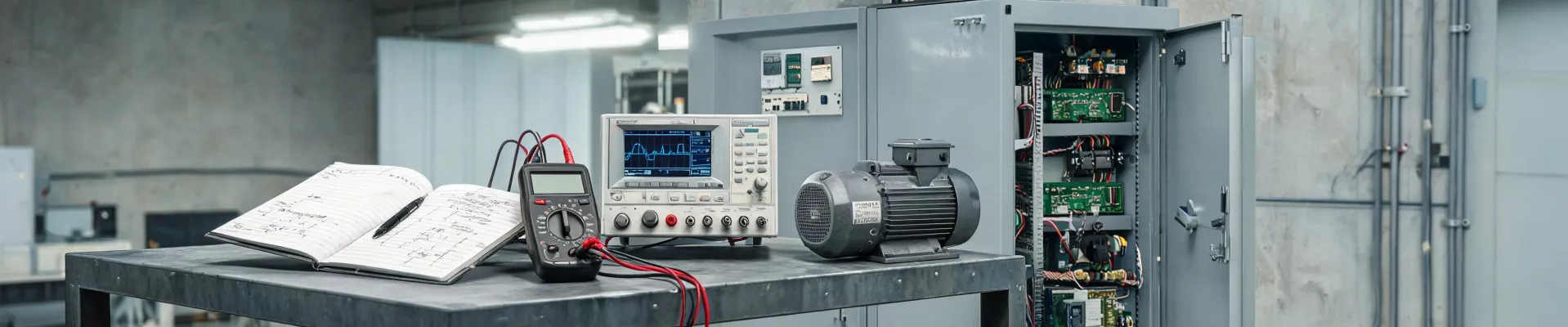
Buy the Extech 410 for your team. Don't buy a wholesale lot of anonymous meters just because they're cheaper—I've made that mistake, and it cost me more than the savings were worth.
I'm the office administrator for a facilities services company with about 200 employees across three locations. I manage all equipment and tool ordering—roughly $40,000 a year across 15 vendors. I report to both operations and finance, which basically means I get squeezed from both sides. I'm not an electrical engineer, so I can't speak to the finer points of circuit design. What I can speak to is the math of putting reliable test instruments in the hands of technicians.
Why the 410 became our default multimeter
When I took over purchasing in 2020, our techs were using whatever the previous person had bought. A mix of cheap meters, some recognizable brands, and one that honestly looked like it had been through a flood. There was no standard, no tracking, no plan. That's exactly the kind of situation where small problems quietly get expensive.
I looked at what our techs actually do daily: measuring AC/DC voltage, checking current draw on compressors and motors, verifying continuity, troubleshooting HVAC controls. Nothing exotic. The Extech multimeter 410 covers all of it. It's rated CAT III 600V, which for commercial building work is a defensible baseline. Safety standards like IEC 61010-1 define these overvoltage categories, and the CAT rating tells you how much transient energy a meter can safely handle. For work inside commercial panels, CAT III is the minimum I want in a tech's hands.
So I bought a batch of 410s and ran side-by-side tests against our existing meters on known references. The results were alarming. One old meter read 115.8V on what should've been a 120V line. Another showed continuity across an open switch. Nobody had flagged these problems because nobody was tracking accuracy. We were flying blind.
The 410 isn't flashy. It's true RMS, which means it handles non-linear loads better than the average cheap meter. It has a backlight, which matters way more than you'd think in a dim mechanical room. The case feels good in hand. But none of that is why I kept buying them.
I kept buying them because they don't fail. Four years in, we've had zero 410s fail in the field. One got knocked off a ladder and cracked its case. Another got splashed with water. Both kept reading accurately. I can't say that about any cheap meter we used before.
What “sensor private label” taught me about buying
Choosing a multimeter was actually the easy part. Finding a dependable sensor supplier was harder—and the lesson changed how I think about brands entirely.
We needed temperature and humidity sensors for building automation systems across the properties we service. The natural instinct for someone like me, measured on cost, is to look at private label options. The pitch is tempting: put your own name on the product, skip the brand markup, save 20-40% per unit. On paper, it's a no-brainer.
In practice, I learned never to assume “same specifications” means the same production standards. In 2023, we sourced a batch of private label sensors at a great discount. The spec sheet matched. The samples checked out. But the production batch drifted out of tolerance within four months. Sixty sensors across three sites. The replacement labor cost was more than triple what we saved on the purchase.
That experience rewired my thinking. A real brand like Extech has decades of reputation behind every product. When something goes wrong, they can't pack up and rebrand. A private label supplier can disappear and restart under a new name next month. The brand markup isn't just a fee—it's insurance.
Now, whenever I evaluate a sensor supplier, I ask three questions: who actually manufactures the sensing element, what quality controls exist, and what happens if a batch fails. The logo on the housing matters less than what's underneath.
A practical multimeter wholesale cost guide
“Wholesale” gets thrown around loosely, so let me give you real numbers. Based on U.S. wholesale pricing we've seen from late 2024 into early 2025:
- Generic no-name meters: $15-$25 per unit. A 30-unit order runs $450-$750.
- Extech 410 at wholesale volume: roughly $55-$75 per unit. A 30-unit order runs $1,650-$2,250.
That gap looks significant, and finance will definitely notice. But here's the math that changed my mind:
In our first six months with cheap meters, we had two complete failures and three that drifted out of acceptable accuracy. Replacing those five meters cost $75-$125 in hardware—plus labor hours spent figuring out which readings couldn't be trusted. The bigger hit came from having technicians re-check work that might have been done with bad readings. At $45-$65 per hour for skilled labor, one hour of rework across 20 techs wipes out the entire cost advantage of buying cheap.
Over four years, our Extech units have cost exactly $0 in replacement and repair. The cheap route would've cost at least $1,800 in replacements by now, before a single hour of labor. Total cost of ownership isn't even close.
Calibration is the other piece. Every meter drifts over time, including Extech. But our 410s have held their stated accuracy well, and the ones that needed recalibration were easy to send out. With a no-name meter, most calibration labs won't even look at it. If your clients expect documented accuracy, that alone eliminates the budget option.
When I'd tell you to buy something else
The honest part: Extech isn't right for everyone, and anyone who tells you otherwise isn't thinking clearly.
If you're a homeowner or hobbyist: don't buy a wholesale lot. Buy a $20-$30 meter from any reliable store. You'll use it occasionally, and the accuracy will be perfectly fine.
If you're working on utility-scale or substation equipment: you need CAT IV-rated instruments with features the 410 doesn't offer. That world has its own rules, and I'm not the person to tell you exactly what to buy. This gets into electrical engineering territory, which isn't my expertise. I'd recommend consulting an engineer who does that work daily.
Here's the rule of thumb I've developed: Extech fits about 80% of commercial and industrial maintenance applications. If you're in that 80%, the math usually works. And here's a quick test: ask yourself what happens if a reading is wrong. If the answer is “annoying,” a cheap meter is fine. If the answer is “someone could get hurt,” you need the predictable one.
Bottom line
I didn't start out as an Extech buyer. I started out as a cost-cutter, and I made the classic rookie mistake in my first year: ordered 40 discounted meters from a new supplier, saved about $1,600 against our prior budget, and then watched accounting reject $2,400 in expenses because the vendor couldn't provide proper invoicing. Learned that lesson the hard way.
What I've settled on is simple: buy the best instrument you can justify, not the best one you can find. For our team, the Extech 410 is that instrument. It's not the cheapest, and it's not the most advanced, but it's predictable. Predictability, in this job, is worth more than the price difference.
If you're evaluating multimeter wholesale suppliers, run the numbers for your own situation. Compare total cost of ownership, not just the per-unit price. Ask your techs what they actually measure day to day. And if you land on Extech, great—but the real win isn't the brand. It's making a deliberate choice instead of a cheap one.

Rebecca Sloan
Rebecca Sloan is a power distribution and protection analyst specializing in circuit breakers, switchgear, contactors, fuses, surge protective devices, and coordination. She applies IEC 60947-2 breaker requirements, IEC 60269 fuse characteristics, and IEC 61643-11 tests while examining rated voltage, breaking capacity, time-current curves, selectivity, and prospective short-circuit current. She helps engineers and buyers compare protective devices against documented fault levels, installation conditions, maintenance access, and continuity priorities.